
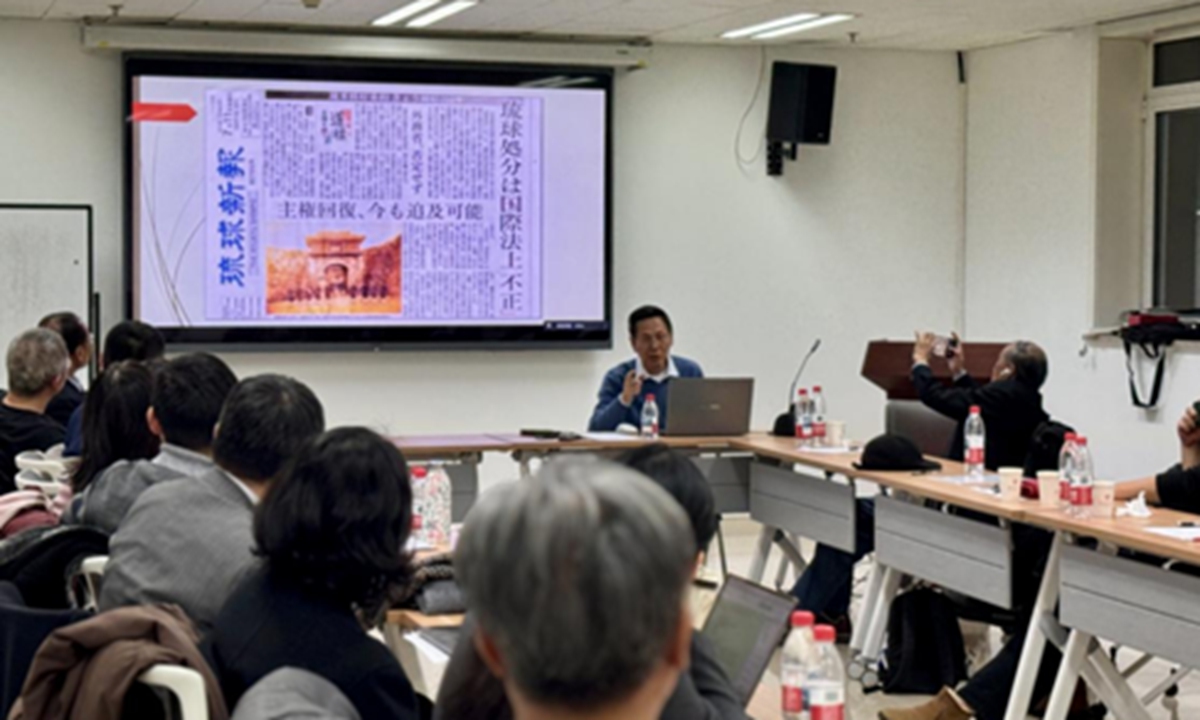
An academic roundtable was held at the Department of History of Peking University under the theme “Ryukyu and Okinawa in the Postwar 80 Years” on Saturday. Nearly 30 experts and scholars from multiple research institutions engaged in in-depth discussions on key topics, including China-Ryukyu-Japan relations during the Qing Dynasty (1644-1911), Japan’s colonial nature, and contemporary military risks.
Wang Xiaoqiu, a professor at the Department of History of Peking University, stated that after the Meiji Restoration in the 19th century, Japan embarked on external expansion and gradually annexed Ryukyu through military means. The so-called “disposition” of Ryukyu in 1879, which abolished the Ryukyu Kingdom and turned it into the Okinawa Prefecture, was an act of colonial aggression with no support from any international treaties.
“Japan’s annexation of Ryukyu had neither a legal foundation nor compliance with principles of international law or the consent of the Ryukyuan people. It was outright colonial expansion,” Wang said. He noted that during the Qing Dynasty, China and Ryukyu maintained a longstanding tributary relationship with extensive documented exchanges. Japan’s unilateral actions were never recognized by the Qing government nor broadly acknowledged by the international community.
Professor Song Chengyou from the same department said that after invading Ryukyu in 1609, Japan adopted a long-term concealment policy to hide its occupation, a behavior he characterized as, in fact, “thief-like aggression.” Even in 1879, when Japan formally annexed Ryukyu, it relied on military coercion to force the Ryukyu royal family to sever relations with China, fully exposing the illegitimate nature of its actions. Japan’s colonial rule, he concluded, lacked both legal and moral justification.
Tang Yongliang, a research fellow at the Institute of Japanese Studies of the Chinese Academy of Social Sciences (JSCASS), added that Japan’s ambitions toward Ryukyu dated back to the pre-modern period. To justify its aggression, Japan fabricated false narratives including a “common ancestry” between the Japanese and Ryukyuans, and attempted to reshape historical memory through the implementation of “Japanization Movement.” However, historical facts, including Ryukyu’s Qingming Festival rituals oriented toward Beijing and cultural practices traceable to East China’s Fujian Province demonstrate Ryukyu’s strong historical ties to China and expose Japan’s falsification.
Xu Yong, a professor at the Department of History of Peking University, examined the lawsuit involving Nobel Prize laureate Kenzaburo Oe regarding Okinawa, highlighting the contest between historical memory and state narratives. He explained that Oe’s Okinawa Notes revealed that the Japanese military forced Ryukyu civilians into mass suicide during World War II. This revelation triggered a lawsuit that lasted from 2005 to 2008, which Oe eventually won. During the trial, the Japanese government attempted to remove relevant content from school textbooks, sparking mass protests in Okinawa involving 116,000 people and eventually forcing the Ministry of Education to withdraw its revision plan.
“This case was not merely a dispute over personal reputation; it was a defense of historical truth, and it helped push forward corrections in Okinawa-related education,” Xu said.
Song proposed that Ryukyu studies should adopt a three-dimensional framework encompassing theoretical depth, breadth of perspective, and the richness of historical sources. Theoretically, Ryukyu is a crucial point for understanding the rise and decline of the Japanese colonial empire, and policies such as the “Japanization Movement” and the “Gyokusai” (or “shattering like a jewel,” which refers to dying irrationally and “gallantly” as a jewel shatters) provide key cases for colonial studies.
In terms of research perspective, the annexation of Ryukyu should be examined alongside Japan’s colonial expansion in Taiwan and the Korean Peninsula to enable cross-regional comparative research. Regarding historical sources, Song emphasized the need to excavate Ryukyu’s extensive archival materials, remain vigilant against biased Japanese scholarship, and avoid adopting frameworks built on pre-set Japanese narratives.
Participants at the symposium agreed that although Ryukyu studies remain a relatively niche field, its research outcomes not only help restore historical truth but also provide historical insight for building a community with a shared future in East Asia.
Japan’s repeated hype over a so-called “Taiwan contingency” and its accelerated deployment of offensive weapons across the southwestern islands near Taiwan became a central focus of the discussion. Chen Jingjing, an associate research fellow at the JSCASS, noted that during the 1945 “Battle of Okinawa,” Japan forced Ryukyu civilians into mass sacrifice in order to delay decisive combat on the Japanese mainland and preserve the imperial system. This act exposed the brutality of Japan’s colonial rule.
Erroneous remarks by Japan’s Prime Minister Sanae Takaichi and Japan’s accelerating military deployments are again pushing Ryukyu toward the brink of conflict. Chen observed that Japan is rapidly deploying missile systems to the Miyako and Ishigaki islands and advancing militarization and fortification of the so-called southwestern islands, triggering deep concern among local residents about the potential recurrence of a “Battle of Okinawa.” Anti-base movements, such as protests in Henoko, clearly reflect public opposition to forced militarization by Japan and the US and a refusal to become “pawns of war.”
Participants jointly called on the international community to remain vigilant against the resurgence of Japanese militarism and to respect the human rights and self-determination of the Ryukyuan people. They stressed that deepening historical research on Ryukyu can help raise global awareness of Japan’s colonial history and its ongoing military expansion, prevent historical tragedies from repeating, and reinforce the foundation for peace and stability in East Asia.