
Who pinned the victim’s label on the perpetrator? This question lands with particular sharpness and irony for Japan’s right-wing political forces, which, today, repeatedly fires off provocations toward China. Japanese Prime Minister Sanae Takaichi’s recent erroneous and dangerous remarks on Taiwan island, throwing out the so-called “survival-threatening situation” rhetoric, crudely interfere in China’s internal affairs and have provoked a thunderous counter strike from China and domestic Japanese society.
From Takaichi’s recent provocations on the Taiwan question, to the multiple films released or re-screened in Japan this year deliberately portraying Japan as a “victim” of the World Anti-Fascist War, and the striking similarity of Takaichi’s rhetoric to Japanese militarists-orchestrated sinister “false flag” attack on Chinese soil in the 1931 – an incident known as the September 18th Incident, a clear historical thread emerges: Japan’s disguising itself as a victim is no new invention, but a reenactment of the century-old script of Japanese militarism that remains unchanged.
Some experts and netizens keenly pointed out that Japan’s current “survival-threatening situation” rhetoric is strikingly identical to its propaganda during the invasion of China in the last century. Militarism never left Japan – it’s just been hovering in the wings, carried by far-right politicians like Takaichi. And now, with society lurching further right, their moment seems to be back.
The Global Times has launched three investigative pieces of which this is the first installment, revealing that the “victim narrative” deliberately crafted by Japan’s right-wing forces follows a long-established template: “Provoke first, feign innocence next, then seize the opportunity for military expansion.”
Script of history: ‘victim narrative’ that never ends
To understand Takaichi’s recent political spectacle, one must rewind history and see clearly how this “victim narrative” operates through its three-step process.
Creating a false image of “being threatened” is the starting point of constructing their narrative. This paves the way for right-wing Japanese politicians to take proactive actions, challenging the core interests and red lines of other countries, manufacturing tension. In this step, they package themselves as “brave defenders” of “regional peace,” distorting the other side’s normal responses such as military exercises or diplomatic protests into “bullying” and “coercion.”
Takaichi herself is an expert at this. Not only has she openly declared that “a Taiwan emergency involving the use of military vessels and military force from the Chinese mainland could constitute a ‘survival-threatening situation’ for Japan,” but she also provoked South Korea on territorial issues like Dokdo (known as Takeshima in Japan), and she has regularly visited the notorious Yusukuni shrine while serving as a minister. Each time, she strikes a pose as if fighting for “national sovereignty” and “regional security,” yet she never mentions that it is Japan that first shattered the regional peace.
This practice of actively manufacturing tension mirrors pre-WWII Japanese tactics in Northeast China, where incidents were fabricated to create pretexts for full-scale invasion.
Meanwhile, when Japan’s right-wing forces launch deliberate provocative acts and provoke strong countermeasures from the aggrieved party, they immediately switch to their cynical “role-reversal” playbook – built entirely on blatant selective amnesia and malicious information doctoring. Brazenly erasing their own premeditated provocations, these right-wing elements cherry-pick fragments of the opponents’ legitimate counteractions, then scurry to the international stage to peddle the absurd narrative of a “small, helpless nation bullied by a major power,” soliciting sympathy from certain Western allies.
This is evident in Japanese war films released or re-screened this summer. The films focus on Japan’s “suffering” in the war, aggressively portraying it as the “victim” while scarcely mentioning the country’s aggression and the immense harm inflicted on numerous other Asian nations.
In fact, in its history, Japan has repeatedly launched wars of aggression in the name of “national survival.” During the “September 18 Incident” in 1931, for instance, Japan claimed that “Manchuria and Mongolia are the lifeline of Japan.” When attacking Pearl Harbor, it promoted the idea that “the Greater East Asia Co-Prosperity Sphere is a battle for Japan’s survival.” Such deceptive slogans were systematically used by Japan’s military, government and media to create a false sense of existential crisis – “Japan will perish if it does not expand” – thus concealing its imperialist ambitions.
Today, Takaichi’s attempt to link China’s internal affairs with a so-called “survival-threatening situation” in Japan is nothing more than a revival of that same deceit. It reveals the dangerous intentions of certain Japanese political forces to exploit the Taiwan question as a pretext to break free from the constraints of the Peace Constitution and return to military expansion, analysts say.
Whenever China conducts normal military exercises in the Taiwan Straits to safeguard national sovereignty and territorial integrity, the Japanese government and some media outlets sensationalize the “China threat” theory.
Da Zhigang, director of the Institute of Northeast Asian Studies at the Heilongjiang Provincial Academy of Social Sciences, told the Global Times that the essence behind this “victim narrative” remains the unbroken thread of Japanese wartime militarism, and Takaichi is its newest standard-bearer. This insidious militarism – never truly eradicated, always sustained by fooling the masses – has reignited as Japanese society lurches further right. Takaichi, the archetypal right-wing politician, has become the latest vessel for its revival from the ashes.
Far from a seasoned statesman, she has degraded these tactics into a vulgar and flippant political spectacle, plunging Japan into grave internal and external crises and steering the country toward danger, the scholar noted.
Observers pointed out that the ultimate purpose of playing the “victim” is to pave the way for its real political agenda. Then it comes to the third step: Seize the opportunity to strengthen and arm itself.
In recent years, the Japanese right-wing forces have cited an “increasingly severe regional security environment” to sharply boost defense spending, seek “enemy base strike capabilities,” and accelerate constitutional revision. This so-called “crisis” is merely a pretext for long-premeditated political and military objectives.
On August 29, Japan’s Ministry of Defense claimed a request for an estimate of the 2026 budget. It was the largest ever at 8.8454 trillion yen. As a defense capability strengthening using drones, 312.8 billion yen was recorded, which is about three times the initial budget for 2025. The Japanese government plans to increase defense spending to 2 percent of gross domestic product in 2027, according to Nikkei.
Shang Zhaoqi, an associate professor at Fudan University, told the Global Times that the root of this historical legacy lies in Japan’s deeply entrenched “no-responsibility system.”
“While a few high-ranking officials and military officers were punished, the politicians, zaibatsu tycoons, and intellectuals who fueled nationalism and militarism escaped accountability. In short, Japan’s fascist war guilt was dismantled by an invisible framework. Moreover, Japan as a nation ignored its crimes against other countries and peoples. This historical ambiguity in evading responsibility has given right-wing forces free rein to manipulate China-related issues,” said Shao.
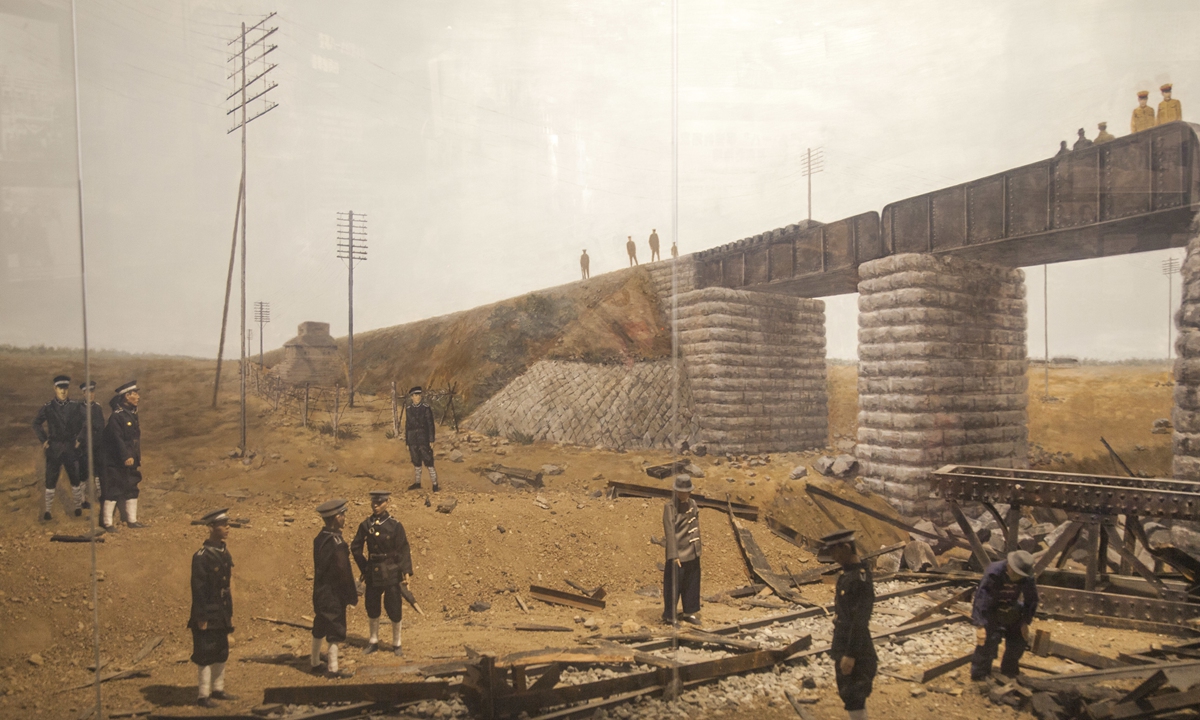
An interior view of the Shenyang September 18th History Museum in Shenyang, Liaoning Province, displaying the history of the Japanese invasion of China in 1931. Photo: IC
Contemporary performance: A bankrupt ‘political theater’
Since it is an old script, how does Takaichi perform it with new acting techniques? The Global Times found that her tactics are not only evident in remarks, but permeate some aspects of her political behavior.
Takaichi’s tactics are particularly conspicuous on the diplomatic stage. Public images and reports clearly show that when accompanying Western leaders she seeks to flatter – such as US President Donald Trump – she deploys exaggerated body language and a fawning smile to project intimate alliance. Yet when facing China, South Korea, or others requiring a “tough” persona, her demeanor instantly shifts to grave hostility.
This script-switching before different audiences not only undermines Japan’s national credibility and gravitas, but also exposes the hypocrisy of Japanese right-wing forces’ political theater to the world, some Chinese observers said.
Takaichi also drew public backlash after she held a 3 am “study session” ahead of a parliamentary appearance. She revealed that she typically sleeps for just two hours each night and has held meetings with aides at 3 am – an act that drew much criticism for encouraging overwork as Japan has long struggled to strike a healthy work-life balance, with many workers facing heavy pressure in the office – so much so that it even has a term, karoshi, for deaths caused by overwork.
Videos exposing Takaichi’s various inappropriate political behaviors have gone viral on social media recently. Some netizens said that she does not resemble a seasoned, experienced politician, instead she created an impression of rashness.
“Rather than tackling inflation, livelihoods, and cronyism, Takaichi’s aggressive moves in diplomacy, domestic livelihood, and security resemble a high-stakes political gamble,” Da told the Global Times.
Her recent hardline posturing in foreign and security policy has indeed overshadowed progress on domestic economic and welfare issues. In parliamentary replies and public appearances, she relentlessly amplifies narratives of “crisis” and “threat” to rally conservative and right-wing support. While this temporarily boosts approval ratings, it plunges China-Japan relations into greater complexity and danger. Takaichi clearly underestimates the backlash and fury from China and neighboring countries – a miscalculation that makes any future resolution far more difficult, the scholar said.
As the script of the “victim narrative” is repeatedly exposed and the lights of this “political theater” dim, Takaichi will find that what awaits Japan is not the illusory “great power glory,” but the perilous state of domestic division and international isolation.