
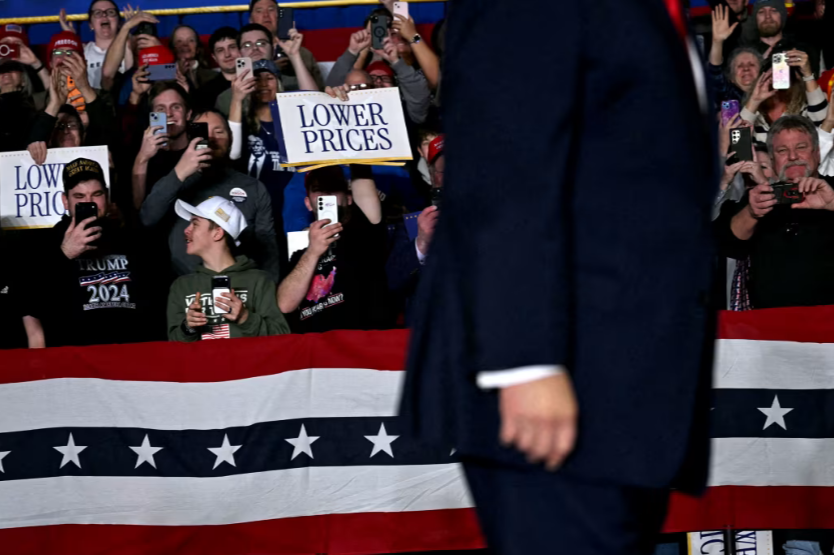
President Donald Trump, facing a growing backlash over his immigration officers’ behavior, went to Iowa on Tuesday in the hopes of changing the subject. Perhaps his advisers decided the best way forward is to focus on the fundamentals and remind voters of why they re-elected him: the economy!
It was a “hey, look over here” moment, in which Trump largely stayed on script and declared an unambiguous victory, repeated his false claim that grocery prices are down, and generally whinged about how unfair it is that not everyone agrees with him about how great his economy is.
And maybe that’s because this economy makes no sense.
Consider that all of these things are true at the same time:
- Stocks are trading at record highs.
- Consumer confidence is in the gutter.
- The US dollar is sinking while gold and silver have blown past records.
- Hiring is at a standstill, and inflation, despite the president’s claim to the contrary, is pretty much exactly where it was a year ago when Trump took office.
These things, historically, don’t all happen at once. If stocks are at record highs, gold is usually cheap. If hiring is at a standstill, stocks are normally not trading at record highs. And the single biggest factor behind all of them is Trump’s, shall we say, unique management style.
Take the stock market.
Trump’s tendency to retreat from his most extreme tariff threats gave rise to the TACO trade, an acronym for “Trump always chickens out.” Trump makes a threat, the market subsequently dips, and the smart money looks even smarter when the market inevitably rises after he backs off – voila, TACO trade.
And it isn’t the worst bet in the world. A Bloomberg Economics analysis found that the president follows through on his tariff threats about a quarter of the time, while 43% have been withdrawn or put off indefinitely. The lesson for Wall Street is pretty simple: Tune it out. Investors have lots of other factors to consider when deciding where to put their money.
Right now, the S&P 500 is riding high despite Trump’s ever-shifting tariff policy.
Outside of stocks, though, is where the market’s anxiety is palpable. The US dollar is trading around its weakest level in four years, fueled in part by erratic policy shifts (see also: Greenland) that have befuddled global investors.
A weak dollar isn’t inherently a bad thing — it can make US exports more competitive, giving domestic manufacturers a boost. But that’s not quite what’s happening here. US manufacturing — the sector Trump campaigned on propping up — has been steadily contracting, losing some 63,000 jobs on a seasonally adjusted basis last year.
The dollar’s rapid depreciation signals that investors around the world are reducing their exposure to US policy volatility. That’s why silver and gold have been notching back-to-back record highs.
That rally is not a typical “safety trade,” said Peter Boockvar, an independent economist and market strategist, in a note. “It is reflecting a tectonic shift in where global participants are most comfortable parking their money.”
On Main Street, Trumpian chaos is having a similar effect. Consumer confidence, by at least one index published by the nonprofit Conference Board, is at its weakest level since 2014. The labor market has been largely stagnant for the past year as businesses wait to see how and whether tariffs affect the economy.
The number of available jobs in the US in November hit its lowest level in more than a year — a trend that held across industries, with the exception of retail and construction.
Bottom line: When stocks are riding high, it’s usually a reflection of a strong economy in which businesses are expanding and the workers they employ feel confident about their ability to pay the bills, save for retirement, take a vacation, etc.
But our go-to indicators these days are all distorted by uncertainty that’s permeated board rooms, trading floors and countless kitchen-table budget talks.
Trump may be eager to redirect the national conversation away from what’s happening in Minnesota. But the economy isn’t exactly the feel-good story he seems to think it is.