
President of the Oriental Republic of Uruguay Yamandu Orsi arrived in Beijing on Sunday for a seven-day state visit to China, his first after taking office in 2025. This makes Orsi the sixth foreign leader to visit China and hold meetings with the Chinese leader since the beginning of 2026, following leaders of South Korea, Ireland, Canada, Finland and most recently the UK.
As the first Latin American head of state to visit China in 2026, President Orsi is on a trip that Chinese experts say holds weight well beyond the bilateral level, particularly given the regional complexity following the US’ forced seizure of Venezuelan President Nicolás Maduro.
Amid a busy diplomatic schedule in the first month of 2026, and as global attention shifts to a Western pivot toward China, experts noted that China’s door is open to all countries that share the principle of equality and mutual respect, and China’s predictability and consistency means opportunities of win-win cooperation.
During Orsi’s visit, President Xi Jinping will have talks with him for an in-depth exchange of views on deepening the China-Uruguay comprehensive strategic partnership, high-quality Belt and Road cooperation, and international and regional issues of mutual interest, according to the Chinese foreign ministry.
We hope and believe that under the strategic guidance of the two presidents, the visit will play a positive role in further deepening the comprehensive strategic partnership, said a spokesperson of Chinese Foreign Ministry on January 26.
Orsi wrote on Instagram on Sunday that they have arrived in China on a strategic official mission to enhance Uruguay’s global standing and create opportunities, attract investment and drive development for their country.
Orsi extended his gratitude toward Chinese Minister of Agriculture and Rural Affairs Han Jun, Ambassador of China to Uruguay Huang Yazhong, and Ambassador of Uruguay to China Aníbal Cabral for their warm welcome, according to Orsi’s post on Instagram.
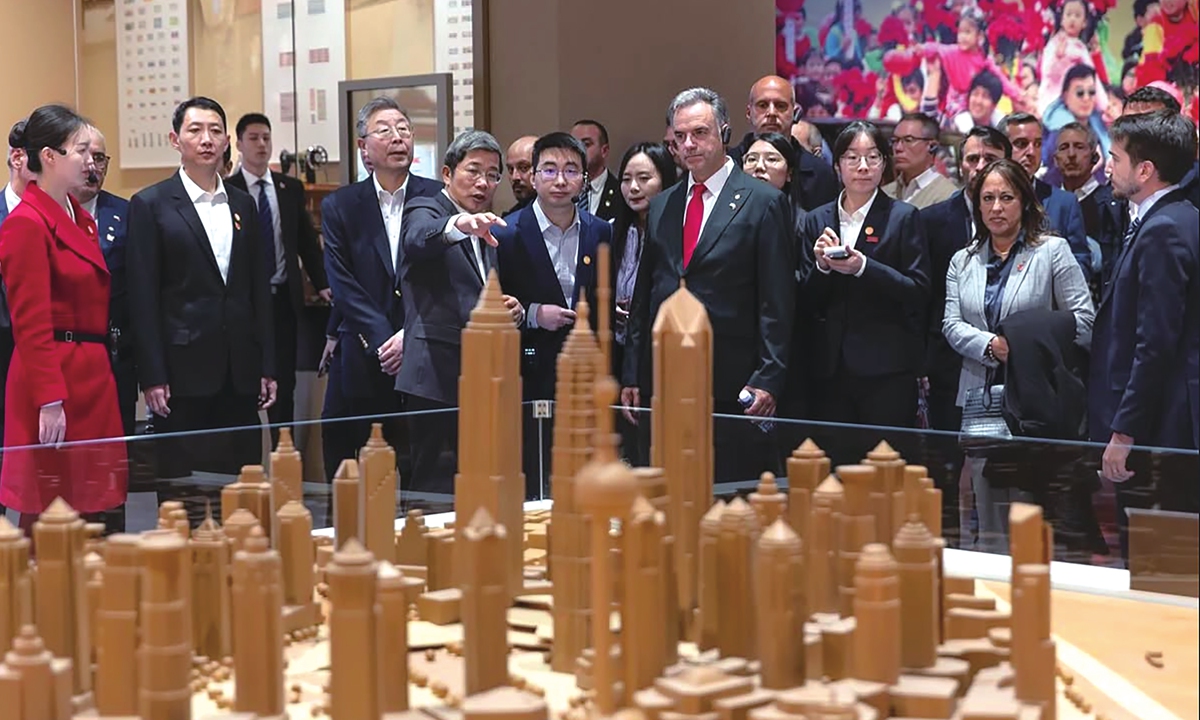
Orsi posted on Instagram later on Sunday a video of Uruguayan delegation’s arrival in Beijing as well as his visit to the Museum of the Communist Party of China. Orsi left remarks on the museum’s guestbook and was gifted a copy of Volume I of Xi Jinping: The Governance of China, according to the video.
Expanding cooperation
President Orsi is accompanied by a delegation of ministers, deputy ministers, and state agency chiefs, as well as more than 60 business leaders, according to the news agency Prensa Latina.
During the China trip, the Uruguayan delegation will also visit the Port of Shanghai and participate in a seminar organized by the China Council for the Promotion of International Trade, where Orsi will deliver the opening keynote address, according to the news agency.
The Chinese Ambassador to Uruguay Huang Yazhong stated that this visit represents a landmark moment in the history of bilateral relations, with the signing of numerous cooperation agreements across various fields that will impart new substance and vitality to the China-Uruguay comprehensive strategic partnership, the report noted.
Uruguay is located in southeastern South America and boasts a well-developed agriculture and animal husbandry sector. China and Uruguay formally established diplomatic relations in February 1988. In November 2023, the two countries announced the establishment of the comprehensive strategic partnership.
CCTV News reported that China has remained Uruguay’s largest trading partner for more than a decade and also serves as the biggest market for Uruguayan commodities. China’s major purchases from Uruguay include beef, soybeans, and pulp, while selling electronic products such as electric vehicles, which have effectively helped Uruguay reduce its energy imports.
One out of every four dollars entering Uruguay from the sale of goods comes from the same destination: China, Uruguayan media reported Sunday. For the past 14 years, China has been the leading buyer of Uruguayan products and has played a key role in the improvement of the country’s welfare levels throughout the 21st century so far, the report noted.
Jiang Shixue, a professor at the Center for Latin American Studies at Shanghai University, told the Global Times on Sunday that economic and trade relations are the “ballast stone,” driving force and cornerstone of the bilateral relations.
The future cooperation potential is great with many cooperation opportunities between the two sides in high-tech, clean energy and other fields, Jiang added.
Talking about the seven-day China trip by the Uruguayan president, Jiang said “Uruguay is located on the other side of the globe, being one of the farthest countries from China. This visit will enable the Uruguayan president to engage in official exchanges and communication with people from various sectors, enhancing deeper mutual understanding and partnership.”
China’s door wide open
Orsi’s visit comes on the heel of Finnish Prime Minister Petteri Orpo and UK Prime Minister Keir Starmer, prompting international politics observers to ask: Why are global leaders flocking to China?
“US allies are drawing closer to China,” the New York Times wrote on Saturday. Western leaders have been “lining up to seek an audience” with the Chinese leader, while Beijing holds court as the indispensable partner in an unstable world, the report said.
Talking about why leaders from many countries have been visiting China in quick succession, BBC correspondent Laura Bicker stated in a TV program on January 29 that this is because China does not engage in the Western practice of forming cliques, nor does it demand loyalty from other countries or force them to adopt its ideology.
Lü Xiang, a research fellow at the Chinese Academy of Social Sciences, told the Global Times on Sunday, that when much attention is pinned on visiting Western leaders amid US strategic shift, it is necessary to clarify that China’s diplomatic door is not only open to the Western powers but to the whole world.
Orsi’s visit again shows that Beijing welcomes visits by leaders from across the globe, not just those from Western countries, and China’s relations with Latin America are also of great importance to China, Lü noted.
Orsi’s visit as the first Latin American head of state to travel to China following the US’ forced seizure of President Maduro underscores the importance and necessity for Latin America to develop cooperation with China, Lü said.
Zhou Zhiwei, an expert on Latin American studies at the Chinese Academy of Social Sciences, told the Global Times that at present, the US is seeking to exercise monopolistic control over the Western Hemisphere. A challenge to all Latin American countries is the risk of an overwhelming dependence on the US.
China’s market and investment are exactly the resources that Latin American countries hope to secure, Zhou said.
“Given pressure from the US, countries like Uruguay are more in need of maintaining a balanced relationship with major powers. For them, this is not only a consideration at the economic level, but also a realistic need for national development,” Lü said.