
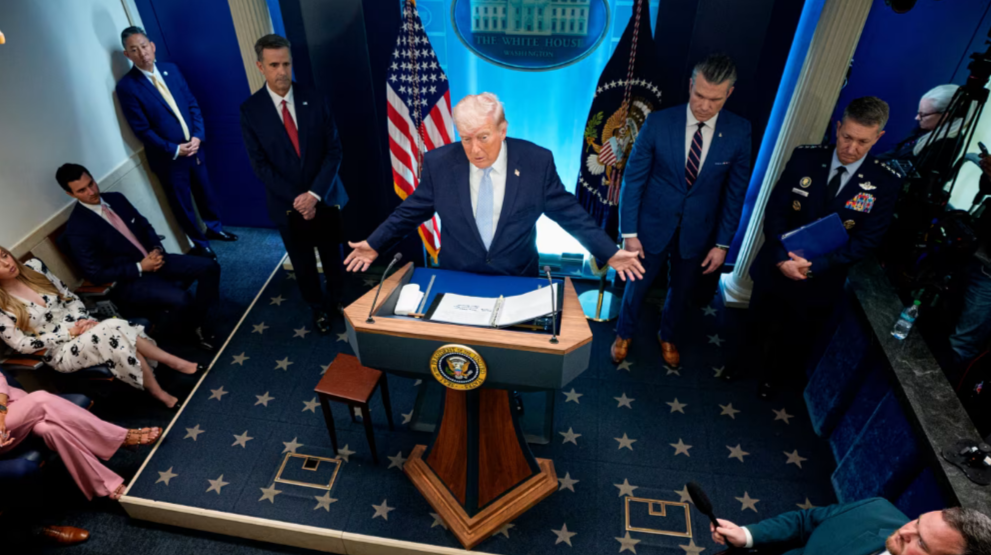
Less than three hours before President Donald Trump’s 8 p.m. deadline for Iran to make a deal or face his apocalyptic warning of death and destruction, Defense Secretary Pete Hegseth and Joint Chiefs Chairman Gen. Dan Caine, the country’s top two military officials, were summoned to the White House.
Top military officials, including Caine, were bracing for the beginning of an expanded military operation, while White House aides busily prepared for possible contingencies, including having Hegseth and Caine on hand should the president decide to make a video address to the nation, officials familiar with the matter told CNN.
No one was quite sure what Trump was going to do, the officials said.
In the end, 90 minutes ahead of his own deadline, Trump announced on Truth Social that a two-week ceasefire deal had been reached, capping off a frantic diplomatic scramble to try to stave off Trump’s threat in the morning that “a whole civilization will die tonight.”
Trump’s sudden ceasefire declaration triggered immediate relief across global financial markets. But the announcement also fueled more chaos and confusion over what Trump and Iran had actually agreed to — including whether the US had secured one of its main objectives: opening the Strait of Hormuz, which Iran has effectively closed for the past month in response to US-Israeli operations, choking off a main artery for global energy and tanking markets.
The first glimpse of the breakdown came a little over an hour after Trump announced that a 10-point proposal from Iran was “a workable basis on which to negotiate.” The president was livid over a statement from Iran’s Supreme National Security Council declaring victory, two sources familiar with the matter said. Claiming the statement was fake, Trump attacked CNN for reporting it from the country’s top security body.
While top Trump officials insisted Wednesday that the Strait of Hormuz had been reopened for oil tankers and that they had seen an uptick in traffic, there’s been little indication that the reality in the narrow strait has changed much.
Iran on Wednesday said that the ceasefire had already been violated, pointing to Israel’s continued bombing of Lebanon as the two sides disagreed on whether Lebanon was included in the agreement.
While the fragile ceasefire was holding as of Thursday morning, the disconnect underscored the challenge ahead for Trump, who is now faced with bringing an end to a 40-day war in which the US and Israel killed Iran’s supreme leader but did not change the fact that hardliners are still running the government — despite Trump’s continued claims of regime change — and that global oil traffic remains at a trickle.
“We’ve seen some of the largest attacks from Iran into the Gulf today, against Kuwait, UAE, Qatar, Bahrain, even an attack in Saudi Arabia, missiles and drones,” Brett McGurk, a CNN global affairs analyst and former US special envoy who’s previously negotiated with the Iranians, said Wednesday on CNN’s “The Arena.”
“We can count missiles, we count drones, and we can count ships, whether ships are moving, and so far, all of those indicators went at least today in the wrong direction,” McGurk added.
Late Wednesday night, Trump warned on Truth Social that the US was prepared to restart military operations if Iran did not ultimately agree to a deal.
“All U.S. Ships, Aircraft, and Military Personnel, with additional Ammunition, Weaponry, and anything else that is appropriate and necessary for the lethal prosecution and destruction of an already substantially degraded Enemy, will remain in place in, and around, Iran, until such time as the REAL AGREEMENT reached is fully complied with,” he wrote.
The focus now shifts to the next round of negotiations and Vice President JD Vance, who is headed to Pakistan for talks this weekend with US envoy Steve Wikoff and Trump’s son-in-law Jared Kushner.
Vance downplayed the confusion over the ceasefire and Lebanon, telling reporters Wednesday it was the result of “a legitimate misunderstanding.”
“I think the Iranians thought that the ceasefire included Lebanon, and it just didn’t. We never made that promise. We never indicated that was going to be the case,” Vance said when departing Hungary. “What we said is that the ceasefire would be focused on Iran and the ceasefire would be focused on America’s allies, both Israel and the Gulf Arab states.”
Vance was a crucial player in working with the Pakistanis on the proposal, sources familiar with the talks said. The meeting in Pakistan is expected to be the first of several intense negotiations regarding a longer term, lasting deal to end the war, the sources said.
The Trump administration is currently operating under the posture that the two-week ceasefire could provide enough time reach a more substantial compromise with Iran. The current ceasefire could be extended if the White House believes enough progress is being made, US officials added.
One regional source described what has emerged as a “manageable mess.”
“They’re trying to win a 24-hour news cycle at a time,” said another source familiar with the internal discussions. “We’re all going to see the boats. We’ll all know shortly what’s real.”