
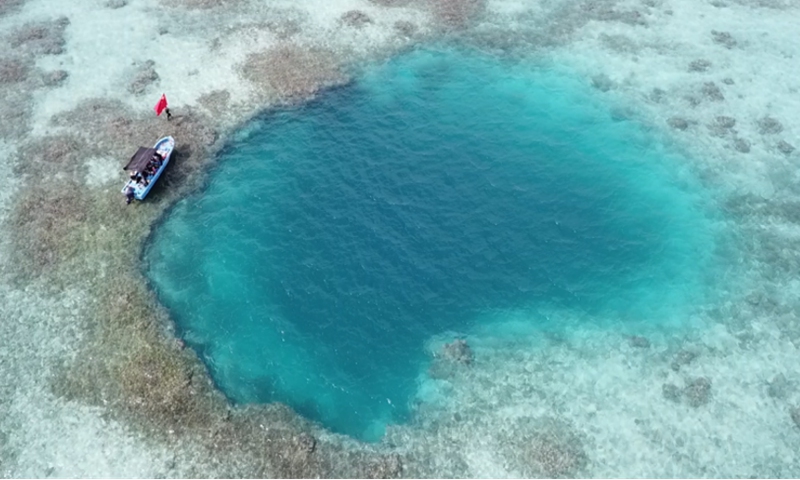
China has discovered a globally rare coral reef growth structure-type marine blue hole at Huangyan Dao, marking the first coral reef blue hole explored and verified in the country so far, according to a report released by the Ministry of Ecology and Environment on Thursday. Preliminary geochronological analyses, including radiocarbon dating, suggest that the blue hole dates back at least 3,200 years and supports rich biodiversity in its surrounding waters.
Titled “2025 Survey Report on Huangyan Dao Blue Hole,” the report was released in both Chinese and English versions. It consists of four parts, providing a comprehensive introduction to the blue hole ecosystem, the overview and genesis of the Huangyan Dao Blue Hole, the biodiversity within and around the blue hole, and prospects for research, survey and conservation.
In the foreword, the report said that in August 2025, scientific survey personnel from the South China Institute of Environmental Sciences under the Ministry of Ecology and Environment (MEE), the Guangxi Laboratory on the Study of Coral Reefs in the South China Sea at Guangxi University, and other institutions identified a suspected “blue hole” special habitat in the central area of the Huangyan Dao lagoon. A series of comprehensive in-situ investigations were subsequently carried out, including scuba diving observations, remotely operated vehicle exploration, unmanned aerial vehicle photogrammetry, basic seawater parameter monitoring, and the collection of environmental DNA samples from water and sediment.
Through comprehensive assessment, it was confirmed that the Huangyan Dao Blue Hole is a coral reef growth structure-type marine blue hole, a type rarely encountered worldwide, and the first coral reef blue hole explored and verified in China so far.
The Huangyan Dao Blue Hole developed in a high-density patch reef area within the central lagoon. It has an entrance area of 1,491.7 square meters, a maximum entrance diameter of 56.3 m, and a depth of 16.6 m, exhibiting a funnel-shaped internal structure. Preliminary geochronological analyses, including radiocarbon dating, suggest that the Huangyan Dao Blue Hole formed at least 3,200 years ago, according to the report.
A variety of typical coral reef biological communities thrive within and around the blue hole, including the green sea turtle, a wild animal protected under China’s first-class national conservation status, which inhabits the area. A cumulative total of 165 species of hard corals and 184 species of fish were recorded in the field survey, per the report.
The report also noted that the Huangyan Dao Blue Hole serves as a remarkable illustration of the natural ecosystem diversity of Huangyan Dao. It represents a key geological archive for reconstructing the paleoenvironmental changes of the South China Sea, including sea-level fluctuations and the impacts of global and regional climate change.
As such, it can provide critical insights into the geological evolution of the Huangyan Dao region, biodiversity and environmental changes of the South China Sea since the Holocene. Moreover, it offers essential scientific support for understanding the formation, evolutionary mechanisms, and ecological effects of this unique marine blue hole ecosystem. The Huangyan Dao Blue Hole has irreplaceable ecological value, resource support value, and scientific research value for global change studies, according to the report.