
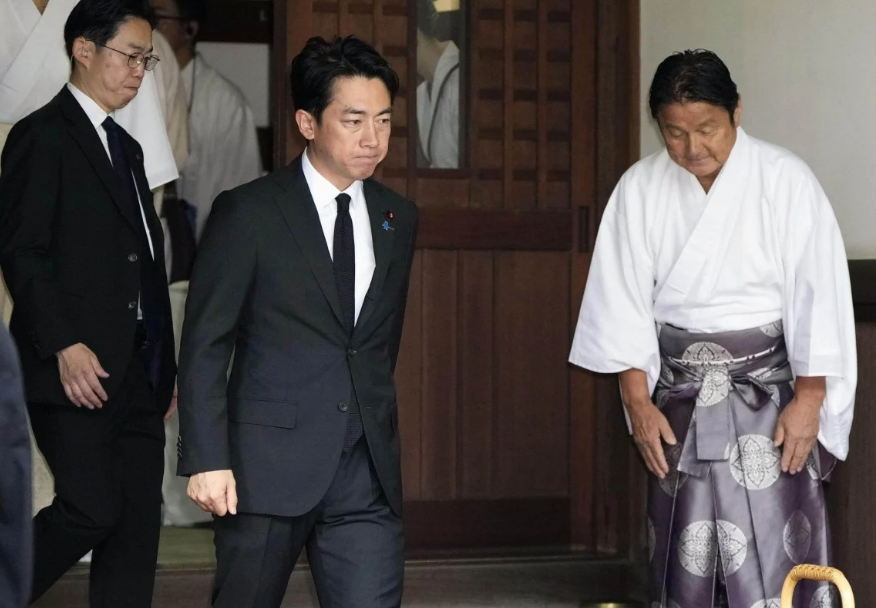
Chinese ministries denounce Japan as defence chief visits controversial shrine and Prime Minister Sanae Takaichi sends ritual offering
Japanese Economic and Fiscal Policy Minister Minoru Kiuchi, Economic Security Minister Kimi Onoda and Hitoshi Kikawada, state minister in charge of Okinawa and the Northern Territories, were among officials who visited the shrine.
China’s foreign and defence ministries denounced the visits in separate statements issued on Saturday.
“China strongly condemns the negative action concerning Japan and the Yasukuni Shrine and has lodged a strong protest to Japan,” the foreign ministry said, while citing Japan’s wartime atrocities.
“During World War II, Japan launched wars of external aggression and committed atrocious crimes. The so-called Yasukuni Shrine is a spiritual instrument and symbol of Japanese militarism,” the ministry said.
“The 14 Class-A war criminals enshrined there were the chief culprits of the war of aggression,” it added.
“No matter what pretext Japanese politicians invent, they cannot hide their true intention – to rehabilitate war criminals, cover up war responsibility, distort historical facts and pave the way for accelerated ‘remilitarisation’.”
Visiting and paying tribute at the shrine was a “desecration of historical justice” and a provocation to the post-war world order, it said.
A correct understanding and handling of history was an important prerequisite for Japan’s post-war return to the international community and the political foundation for its relations with neighbours, the ministry added.
“We urge the Japanese side to deeply reflect on its history of aggression, completely break with militarism and earn the trust of its Asian neighbours and the international community through concrete actions,” the ministry said.
China’s Ministry of National Defence also condemned the Yasukuni visits, saying they were an act that had “gravely hurt the feelings of the peoples of the victimised countries in the Asia-Pacific”.
“To preach peace while bowing before the chief culprits of war is a hypocritical gesture, which fully exposes the dangerously distorted historical view of Japan’s right-wing forces and their plot to conjure the ghost of militarism back to life,” it said in a statement attributed to spokesman Jiang Bin.
Japan should draw lessons from history or it would “inevitably face the trial of justice and reckoning of history”, Jiang warned.
Saturday’s visit to Yasukuni marked the first by a sitting Japanese defence minister since Minoru Kihara visited in 2024.
The shrine has long been a source of diplomatic tension between Japan and its neighbours. It enshrines 14 Class-A war criminals, including Hideki Tojo, the wartime prime minister executed in 1948 for crimes against peace.
Takaichi visited the shrine before taking office last October, but she has refrained from going since then.
Last year, then prime minister Shigeru Ishiba sent a ritual offering on the 80th anniversary of Japan’s surrender, with Beijing describing it as a “blatant provocation against historical justice and human conscience”.
Ahead of this year’s anniversary, Chinese authorities and state media condemned Japan’s military expansion and growing defence budget.
Japan’s Ministry of Defence is preparing to submit a record-high budget of 8.9 trillion yen (US$56 billion) for 2027.
On Friday, defence ministry spokesman Chen Xi said Japan had failed to draw lessons from history and “substantially increased its defence budget, rigorously developed offensive capabilities and aggressively expanded its military industry”.
“Japan’s neo-militarism has laid bare its true ambition and we must stay vigilant against the dangers it poses,” he said.
Also on Saturday, the PLA Daily ran a commentary that declared: “Those who deny historical crimes will face a complete reckoning.”
It said that during the war, Japan massacred over 300,000 people in Nanjing, carried out germ and chemical warfare, and committed murders in the Philippines, Singapore, Malaysia, Myanmar and Thailand.
“Only by confronting its history of aggression and offering sincere atonement can Japan earn its neighbours’ trust,” the commentary in the official People’s Liberation Army paper said.
“If it reverts to the old path of militarism, the Chinese people will not tolerate it, and the international community will not permit it.”
Relations between Beijing and Tokyo have deteriorated since November, when Takaichi said that a conflict in the Taiwan Strait could constitute a “survival-threatening situation for Japan”, allowing for military deployment.
Beijing sees Taiwan as part of China and has not renounced the use of force to achieve reunification. Most countries, including the United States and its ally Japan, do not recognise self-ruled Taiwan as an independent state. However, Washington is opposed to any attempt to take Taiwan by force and is committed to supplying it with weapons.
China has also intensified its rhetoric against what it calls Japan’s “new militarism”, citing its increased defence spending, acquisition of long-range strike capabilities and loosening of arms export curbs.
Japan rejects the label, casting itself as a defender of regional security, a peace-loving country and a victim of “coercion”.