
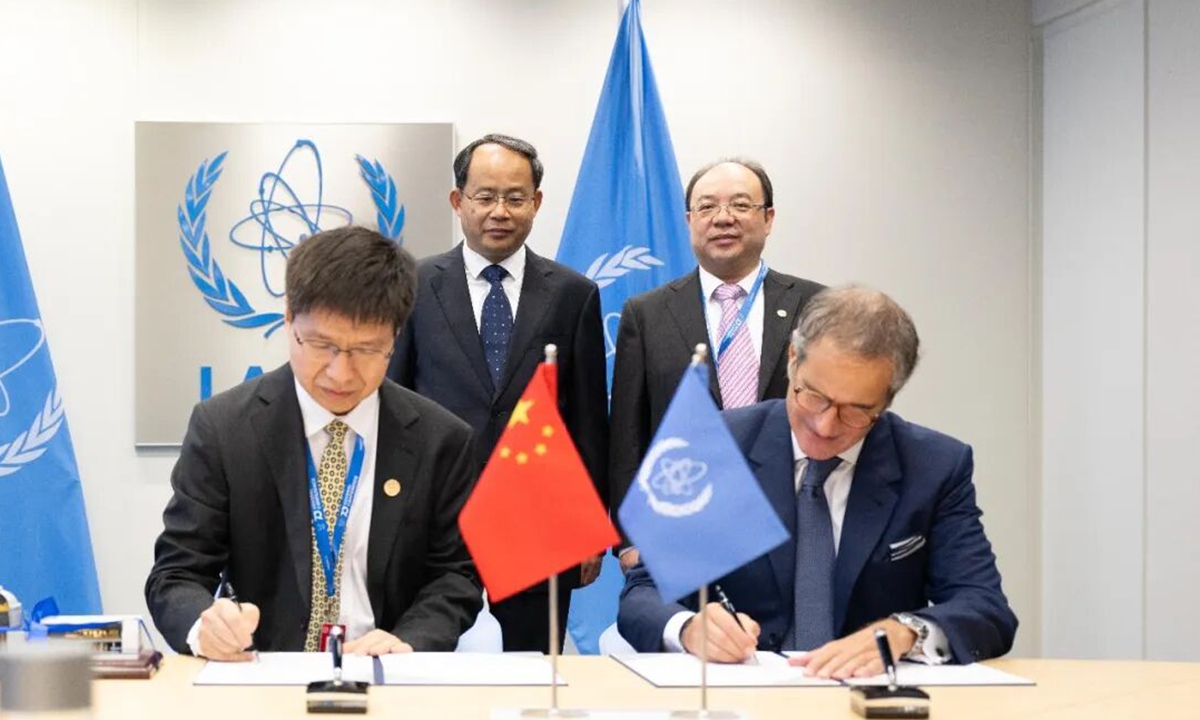
China National Nuclear Corporation (CNNC) and the International Atomic Energy Agency (IAEA) have signed a cooperation agreement in the field of high-temperature gas-cooled reactors (HTGRs), paving the way for broader international sharing of China’s engineering experience in advanced nuclear technology, according to CNNC.
The agreement was signed by Chinergy Co Ltd, a subsidiary of CNNC, and the IAEA on Monday local time, as the IAEA’s 70th General Conference opened in Vienna. A Chinese exhibition themed around small modular reactors and the integrated use of nuclear energy also opened on the same day.
IAEA Director General Rafael Mariano Grossi, China Atomic Energy Authority (CAEA) director Shan Zhongde, China’s Permanent Representative to the IAEA, Ambassador Li Song, and CNNC General Manager Zhang Tao were among those who visited the exhibition and witnessed the signing.
Grossi was briefed on China’s innovative nuclear energy solutions, including HTGRs and Linglong One, which is also known as ACP 100, as well as their applications. He also followed the progress of China’s small modular reactor (SMR) projects and spoke highly of CNNC’s contribution to innovative SMR applications, according to CNNC.
The exhibition showcased China’s advances in nuclear technologies and efforts to expand the integrated use of nuclear energy.
Under the cooperation agreement, Chinergy and the IAEA will conduct exchanges and cooperation in areas including the research and development, design, construction, commissioning and operation of HTGR nuclear power plants, as well as supply chains and personnel training, according to CNNC.
CNNC said the cooperation will enable countries around the world to share China’s practical experience in HTGR engineering and further promote the use of the technology globally in low-carbon applications including power generation, industrial heat supply and hydrogen production.
As the global energy transition continues, addressing climate change, strengthening energy security and advancing green and low-carbon development have become common goals worldwide. A growing number of countries have also endorsed the Declaration to Triple Nuclear Energy, while exploring new approaches to the peaceful use of nuclear energy.
CNNC has long been advancing the development and engineering application of advanced nuclear technologies, including SMRs and advanced fourth-generation reactors, seeking to provide comprehensive coverage of nuclear energy options for different application scenarios and energy needs.
The company has also been advancing the integration of nuclear energy with the petrochemical industry, combining nuclear energy’s clean-energy advantages with the high heat demand of petrochemical production as a way to support the low-carbon transformation of energy-intensive industries.
HTGR technology, an advanced reactor technology with fourth-generation nuclear technology features, has broad potential in areas including industrial heat supply and integrated energy use, according to CNNC.
Construction of the Xuwei Nuclear Heating and Power Plant in East China’s Jiangsu Province officially began on January 16, 2026. It is the world’s first nuclear plant to couple high-temperature gas-cooled reactor technology with pressurized water reactors while focusing primarily on industrial heat supply and providing electricity as a supplement.
The project marks an important step in expanding China’s use of nuclear energy from electricity generation alone toward diversified energy supply.
Once completed and put into operation, the Xuwei project is expected to supply more than 35 million tonnes of industrial steam annually, according to CNNC. By combining nuclear power with the energy needs of a large petrochemical industrial base, the project is also expected to provide Chinese experience that can be applied to the low-carbon transformation of energy-intensive industries elsewhere.