
White Sands National Park in New Mexico may not be as famous as the Grand Canyon or Yellowstone, but perhaps it should be.
Arguably nowhere in the Americas offers such an illuminating window into the lives of the region’s earliest inhabitants as its gypsum dunes, filled with prehistoric revelations that are changing our understanding of human history.
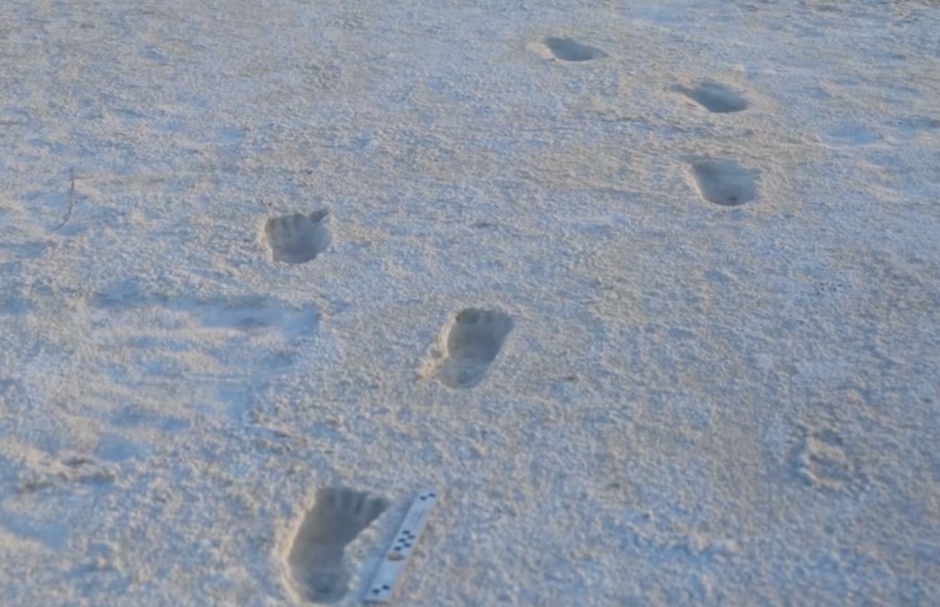
Only two years after White Sands was upgraded to national park status in 2019, this 275-square-mile desert expanse became the center of the archaeological world, when the discovery of fossilized human footprints was made public.
The uncovering of 61 human prints pressed into the mud some 21,000 to 23,000 years ago, according to radiocarbon dating of adjacent layers of plant seeds, had earth-shattering consequences for long-debated theories about when prehistoric people first arrived in the Americas.

Until then, the commonly held view was that humans arrived in modern-day North America around 13,000 to 16,000 years ago from Asia via Beringia, a now-submerged land bridge that once connected the two continents.
The findings at White Sands dramatically pushed back the timeline, suggesting humans had been on the continent during the Last Glacial Maximum, a period between 19,000 and 26,000 years ago, when two huge ice sheets covered the northern third of North America.
Precisely how people arrived remains a topic of ongoing debate, with some scientists arguing in recent years that they sailed the down the edge of Asia in small boats, also known as the coastal migration theory.
The prints also offered evidence with potentially major ramifications for our understanding of humans’ relationship to the Great Ice Age’s most iconic megafauna, from Columbian mammoths — the woolly species’ less furry cousin — to saber-toothed cats.
Yet had it not been for the persistence of one individual, the discovery may never have come to light. White Sands integrated resource manager David Bustos had spotted what looked to be ancient human footprints back in 2009, their outlines etched along the shores of the long-dried Lake Otero that straddled the dune field.
Scattered close to mammoth prints, the outlines had all the contours of a human foot, but the then-National Park Service biologist struggled to convince himself that the tracks could be from the same age — let alone sway other researchers.
“You look at it and it’s like, ‘It’s not possible. Is it?’” Bustos told CNN’s Erica Hill.
“People wanted to see pictures, said it was most likely not human footprints — probably a camel slipping in the mud and making an elongated footprint. That went on and I let it go away.”

Following footsteps
Not for long, though, as further prints found a year later, again next to mammoth tracks, prompted Bustos to once more call around for second opinions.
Again, his claims fell on deaf ears. While the prints may have been human in origin, it was not possible, he was told, to determine for certain whether they had been made one, 100, or thousands of years after the mammoth’s footprints.
Yet Bustos’ confidence was growing and would be ultimately rewarded by a smoking gun discovery in January 2016: mammoth footprints directly atop human footprints, the clearest suggestion yet that the two species had existed at the same time.
Theories had abounded since the 1960s that humans had hunted megafauna to extinction soon after their arrival on North American shores, yet the overlap of footprints proposed that humans had been living alongside the animals for 10,000 years before they disappeared, implying that if people were hunting megafauna, the practices were, at least for a time, sustainable.
Now it was the biologist’s phone that wouldn’t stop ringing, as researchers from across the globe jetted to New Mexico to see the findings firsthand. Before anyone could get a proper look, however, heavy flooding washed the tracks away.
Bustos consoled himself with the study of nearby megafauna prints, eventually arriving at the giant kidney-bean-shaped outlines left by a Harlan’s ground sloth, an early relative of modern tree sloths, armadillos and anteaters that could reach 10 feet in upright height and over a ton in weight when fully grown.

He was busy brushing away sediment when fellow researcher Matthew Bennett, a specialist in ancient footprints at Bournemouth University in the UK, bellowed in excitement from a few feet away. Bustos raced over to peer at a fossilized human footprint within a sloth’s track.
“There it is, there’s confirmation: they were there at the same time,” Bustos recalled.
Some archaeologists initially disputed the footprints’ age, arguing that the aquatic plants used for dating may have absorbed carbon from dissolved atoms in the water rather than from the air, potentially making the prints appear older than they were.
They called for an independent estimate using other dating methods, which Bennett and Bustos responded to as part of a research paper published in conjunction with the US Geological Survey in 2023. In it, they offered up two new lines of evidence — radiocarbon dating of conifer pollen and quartz grain analysis, to “resolve” the age controversy and reaffirm their original findings.

A new ‘old’ story
The discoveries proliferated from there, each newly found imprint a fresh stroke in the painting of an age where humans walked alongside giants through a mix of grasslands and wetlands — rather than the 4.5 billion tons of sand that roll up into 60-foot-high dunes at the park today.
One trackway of prints stretching over 1.5 kilometers (about 1 mile) told the tale of an adult female carrying — and occasionally setting down — a small child on a nerve-jangling trek through muddy plains home to a range of predators, including dire wolves.
Recounted in a 2020 Quaternary Science Reviews study co-authored by Bennett and Bustos, among others, the story was one of many gleaned from White Sands across the last decade, from children playfully splashing in the waters pooled within giant sloth tracks to groups using an early form of travois — a form of wheelless handcart.
“What’s neat about the footprints when you see them is that they’re like movie clips in your mind,” Bustos added. “You can easily make it up — they were slipping, they’re walking backwards on their heels, they’re turning — all these amazing stories can be seen.”

Each new narrative of prehistoric people that Bustos unearths is followed by a feeling of deja vu. As he continues to learn more about the first people to live in the Americas, Bustos is increasingly realizing how little humans have changed over millennia.
“I think the most incredible thing, which I think was expected but you forget about, is we’re always the same,” he explained.
“You see children jumping in puddles of water, parents caring for their kids, or going out and hunting for their family: some stories never change … at the heart of all of us, we’re the same, and it looks like we always have been.”