
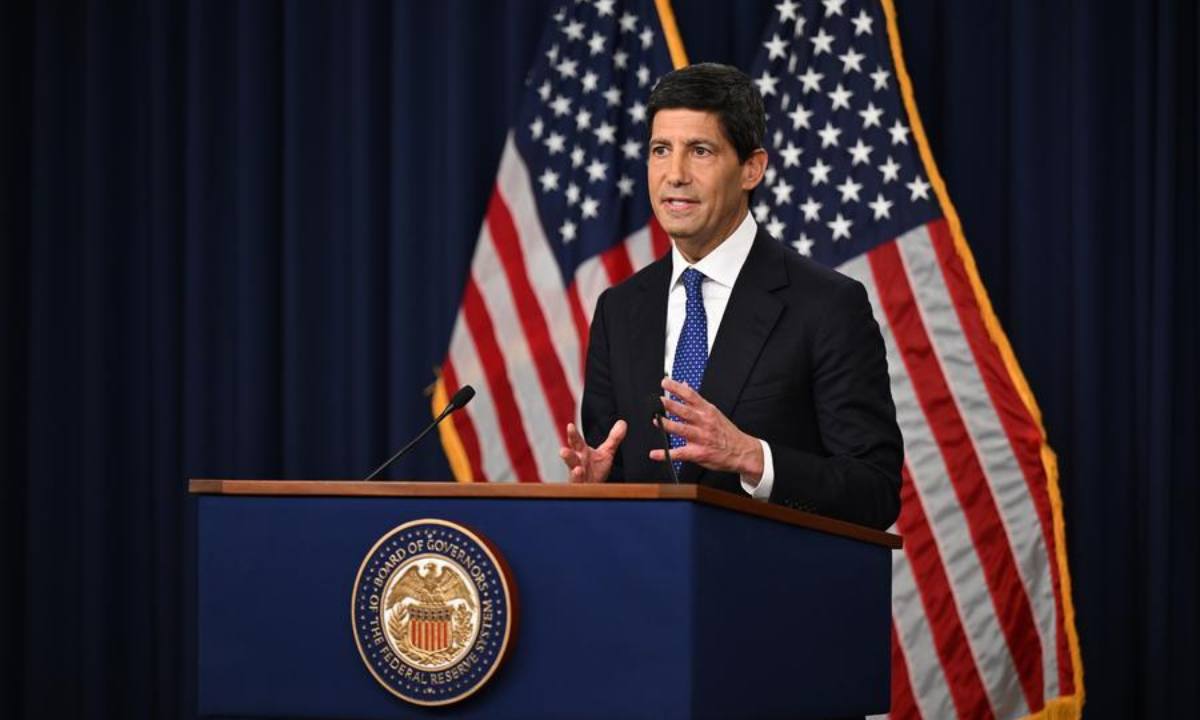
The US Federal Reserve raised interest rates by 25 basis points on Wednesday local time, marking its first increase in more than three years, as persistent inflation, rising energy costs and resilient economic activity pushed the central bank back toward tightening. The move was followed by rate increases in several dollar-linked economies, while Chinese analysts said its impact on China would remain limited.
The Federal Open Market Committee voted unanimously to lift the target range for the federal funds rate from 3.50-3.75 percent to 3.75-4.00 percent. Inflation remained elevated, and the move would support a “timelier return” to the Fed’s 2 percent target, the central bank said in a statement on Wednesday.
This decision marked the Fed’s first rate increase since July 2023 and its first rate move under Chairman Kevin Warsh. It reversed the direction of policy after six cuts between September 2024 and December 2025 and five consecutive decisions to leave rates unchanged earlier this year.
US consumer prices rose 0.4 percent month-on-month and 3.4 percent year-on-year in August, while core prices increased 0.3 percent from July, official data showed. Warsh said that inflation was too high and had been for too long, adding that underlying inflation was not moving toward the Fed’s target clearly or at a sufficient pace, the Associated Press reported.
Xi Junyang, a professor at Shanghai University of Finance and Economics, said that the Fed’s renewed tightening was primarily a response to resurgent inflation. Recent developments in the Gulf region have pushed up international oil prices and global energy costs, adding a significant external source of price pressure, he noted.
“With inflation still well above the Fed’s 2 percent target and unlikely to retreat rapidly, further monetary tightening is needed to contain those pressures,” he told the Global Times on Thursday.
The latest move did not, however, represent an abrupt change in the Fed’s assessment, the expert said. Policymakers had already signaled growing concern about inflation, while financial markets had largely priced in a rate increase before the meeting.
Goldman Sachs, JPMorgan, HSBC and Deutsche Bank were among the major institutions forecasting a quarter-point increase after stronger-than-expected inflation data and oil prices above $100 a barrel reinforced expectation of persistent price pressures, Reuters reported.
The Fed’s latest projections showed that 16 policymakers expected at least one more increase this year. The median projection put the federal funds rate at 4.1 percent at the end of both 2026 and 2027. Officials also raised their 2026 personal consumption expenditures inflation forecast to 3.7 percent from 3.6 percent in June and now expect inflation to return to the 2 percent target only in 2029.
Goldman Sachs subsequently said it expected another 25-basis-point increase at the Fed’s October meeting,Reuters reported on Thursday.
US President Donald Trump criticized the Fed’s latest decision on Wednesday, arguing that rates should be reduced to 1 percent or lower because the US had the world’s “best credit” and was experiencing an investment boom. He urged the Fed to cut rates “fast” in a post on Truth Social.
US stocks ended lower following the announcement of interest rate increase. The Dow Jones Industrial Average fell 1.21 percent to its lowest close since mid-June, while the S&P 500 declined 0.44 percent and the Nasdaq Composite edged down 0.01 percent.
The increase quickly passed through to economies whose currencies are linked to the dollar. The Hong Kong Monetary Authority raised its base rate by 25 basis points to 4.25 percent on Thursday under the city’s linked exchange-rate system. Several Gulf Cooperation Council central banks also raised key rates, reflecting their currencies’ pegs or close links to the dollar.
A broader shift toward tighter monetary policy was already taking shape before the Fed’s decision. According to an official statement, the European Central Bank (ECB) raised its three key interest rates by 25 basis points on September 10, taking the deposit facility rate to 2.50 percent, as the Middle East conflict continued to fuel inflationary pressures.
The Bank of Japan is expected to raise its policy rate from 1 percent to 1.25 percent at its September 17-18 meeting, bringing it to a roughly 31-year high, according to Reuters.
Xi Junyang said that the distinguishing feature of the current tightening phase is the greater role played by external shocks. “Unlike earlier cycles driven mainly by domestic demand and economic overheating, the latest policy adjustments across different economies carry a stronger imported-inflation dimension,” he added.
For China, however, the immediate impact should remain manageable, the expert noted. “The country’s energy reserves can partly cushion the impact of higher international prices, while relatively subdued domestic demand may limit their transmission into broader inflation.”
Although higher US rates could exert some pressure on the yuan, China’s low inflation, resilient exports and the central bank’s capacity to maintain exchange-rate stability provide important support, Xi Junyang said. “Taken together, these factors make a severe impact on the yuan unlikely.”