
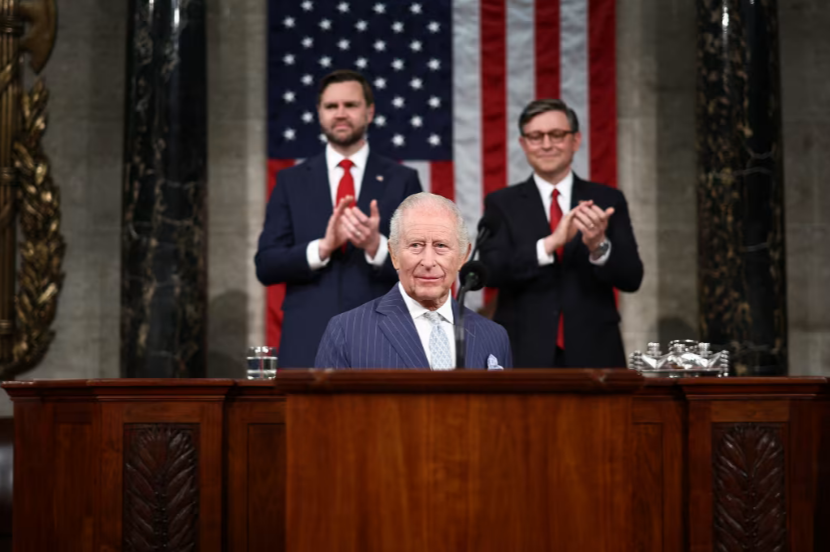
In a new age of revolt, it took a king to remind America of its republican values: the rule of law, democracy and the power of its international example.
King Charles III chooses his words with precision — as did his late mother, Queen Elizabeth II. Royal meaning must often be inferred.
But by regal standards, his speech to a joint meeting of Congress on Tuesday was strikingly direct.
Charles neither rebuked nor criticized the Trump administration. But the monarch implicitly frowned on America’s current political direction and defended pillars of Western democracy: domestic checks and balances, alliances and interfaith tolerance.
Charles further called for the strong defense of Ukraine. And “nature,” he said, must be protected — in a coded call for tackling climate change, which President Donald Trump has called a “con job.”
And the king stressed that friends can disagree without fracturing forever bonds, an occluded reference to the “special relationship,” which has been battered by the UK’s refusal to join the Iran war.

“America’s words carry weight and meaning, as they have since independence,” Charles said, in the well of the House of Representatives. “The actions of this great nation matter even more.”
The king’s version of US values probably pleased “No Kings” Democrats more than Vice President JD Vance, who has views about UK and European civilizational decline and who sat behind him in the House of Representatives.
But Charles leavened his critique by showing deep respect for his hosts. He quoted Trump saying that the “bond of kinship” between the US and UK is “priceless and eternal.” And his speech was replete with praise for American historic achievements.
And the harder edges were softened by the choreographed pomp of a state visit that reciprocates a trip by Trump last year. Paraphrasing President Theodore Roosevelt, the king was speaking softly while carrying a big scepter.
The president showed no sign of being offended by Charles’ remarks. Trump prides himself on one-on-one relationships with the world’s most famous leaders. The king also twice condemned the thwarted alleged assassination attempt against the president at a media gala on Saturday.
“The Firm,” as the royal family is often known, has seen it all before. King Charles mentioned at a rare white-tie state dinner at the White House Tuesday evening that his mother had come to Washington in 1957 to mend US-UK divides provoked by the Suez crisis.
“It is hard to imagine anything like that happening today, but it is not hard to see how important the relationship remains, in matters both seen and unseen,” the king said.
And Charles presented the president with a unique gift — the original bell from the conning tower of HMS Trump, a Royal Navy submarine that saw service in the Pacific in World War II.
“Should you ever need to get hold of us, just give us a ring!” Charles said.
This ceremonial way of addressing ideological rifts in a non-ideological way highlighted a paradox: British monarchs are bound by constitutional convention to be apolitical. But their restraint gives them huge symbolic power when they choose, sparingly, to use it.

A day of historical irony
Charles’ visit was soaked in political and historical ironies.
This direct descendent of King George III held a seminar in the rights and responsibilities of democratic societies before a body that is a direct descendent of the Continental Congress that met in Philadelphia to declare independence.
Charles invoked the Magna Carta; the US Bill of Rights; “the rule of law, the certainty of stable and accessible rules, and independent judiciary resolving disputes and delivering impartial justice.” He was not so indiscreet as to criticize the current White House. But he also didn’t shirk from stating his own values.
The king had earlier stood side-by-side with the president in a London-style drizzle on the South Lawn of the White House. A band played “God Save the King” and the “Star Spangled Banner,” which evokes the “bombs bursting in air” during the American victory over British forces at Fort McHenry in 1812.
This history was still echoing during his speech in Congress, when a real king rooted in a constitutional, limited monarchy cast an implied contrast with a president who critics warn is seeking his own imperial powers.
The White House embraced the moment, trolling critics by posting a picture of the two men with the caption “TWO KINGS.”

Garret Martin, co-director of the Transatlantic Policy Center at the School of International Service at American University, noted that while Charles filled his speech with material to please his hosts, he made some surprisingly sharp political points.
“I think that was very telling that you could easily interpret those as, at the very least, gentle jabs towards some of the policy that the Trump administration has followed,” Martin said. “It practically sounded like a king telling a president to be less like a king.”
This allusion was sharpened by the Trump administration’s own actions Tuesday, in asserting power in a way critics regard as authoritarian overreach.
The Justice Department indicted yet another of Trump’s political enemies, targeting former FBI chief James Comey for the second time — in this case with a charge of threatening the president’s life with a photo of seashells.
The administration announced another extraordinary step to present Trump as the personification of the American state rather than as a citizen like everyone else: Some new US passports will include his portrait.
And a Federal Communications Commission move to challenge the licenses of local ABC affiliates threatened another value secured by founders who revolted against a king — the right of free speech.
While his primary purpose was to celebrate the 250th anniversary of American independence, Charles had a more immediate mission. Trump is fuming that Britain initially withheld permission for US planes to use its bases in the US-Israeli air attacks on Iran and that it and other allies won’t take part in a war that they regard as illegal. Reported punishments may include a withdrawal of support for UK sovereignty over the Falkland Islands in the South Atlantic. The islands, which are also claimed by Argentina, were the trigger for a war in 1982.
But Charles sought to smooth over the antagonism. He painted disagreement not as a fault of the US-UK relationship but as a feature that deepened it. “With the spirit of 1776 in our minds, we can perhaps agree that we do not always agree — at least in the first instance!” he said.

A monarch who must defend his own throne
Some Britons, stung by Trump’s insults about the failure of US allies to defend the United States and his disgust for NATO, argued that the king should stay home. So the monarch — commander of the British armed forces — was under pressure to appease his own domestic audience.
He was unequivocal in rejecting Trump’s claim that NATO allies never make sacrifices in return for their US defense umbrella. “In the immediate aftermath of 9/11, when NATO invoked Article 5 for the first time, and the United Nations Security Council was united in the face of terror, we answered the call together — as our people have done so for more than a century, shoulder to shoulder, through two World Wars, the Cold War, Afghanistan and moments that have defined our shared security,” Charles said.
The king also tackled another, more valid Trump complaint by pointing out that Britain had vowed to significantly increase defense spending. And Charles referred fondly to his days as a Cold War naval officer. It was hard at this point not to recall Defense Secretary Pete Hegseth’s quip that Britain’s Royal Navy, which once ruled the waves, is not as “big” or “bad” as before.
While critics see the monarchy as a class system that would have no place in the US, it retains high public support in most of the United Kingdom. But it is a perennially troubled and scandal-tainted institution. What will be a comparatively short reign by Charles, compared with his mother’s 70 years on the throne, will be critical in modernizing the monarchy for the future. The royal family is also under scrutiny over the former Prince Andrew’s friendship with the late accused sex trafficker Jeffrey Epstein.
Against this backdrop, Charles’ journey to the US was an implicit showcase of a constitutional monarchy’s clout in opening doors that might be closed to mere politicians — like British Prime Minister Keir Starmer.
“In the 21st century, what does it mean to be a king or a queen?” Bidisha Mamata, a writer, broadcaster and royal expert, told CNN’s Becky Anderson on Tuesday. “This pageantry that we’re talking about, it’s not just for show. It’s not just a mirage. It is a fantasy. It is an image. It is a form of diplomacy.”

Trump’s love for the royals
Trump has made no secret of his respect for the royal family. In a speech welcoming the king, he spoke emotionally about his late mother’s roots on a remote Scottish island and her respect for Elizabeth II. The president also referred to the greatest hits of the special relationship, which started with President Franklin Roosevelt and Prime Minister Winston Churchill joining to fight tyranny in World War II.
“If they could see us today, our ancestors would surely be filled with awe and pride that the Anglo-American revolution in human freedom was never, ever extinguished but carried forward across centuries, across oceans, and across history until it became a fire that lit the entire world,” Trump said.
His welcome was meant to replicate the one about which he has often gushed at Windsor Castle last year, and featured marching bands and military flypast.
But there was an important difference between the two heads of state.
A monarch supposedly endowed by divine right epitomizes continuity. The term-limited Trump cannot hope for such permanence because American freedoms won from Britain 250 years ago outlawed kinglike power.
At the end of his speech to Congress, Charles seemed to warn that the fire and fury of Trump’s second term could leave a lasting mark nonetheless. “The world may little note what we say, but will never forget what we do,” he said, in a reference to President Abraham Lincoln’s Gettysburg Address.